
Every day, creators spend weeks or even months building digital products they truly believe people will buy. But after launching, many of those products fail to get sales, attention, or real customer interest. The problem is usually not the product itself. The real problem is that they started creating before understanding the market.
A great idea alone is not enough anymore. In today’s online world, successful creators do not just create products. They first validate a digital product idea by researching market demand, understanding customer problems, and identifying the right target audience. This helps them build something people are already searching for instead of guessing what might work.
One of the biggest mistakes beginners make is confusing excitement with demand. Friends saying “That sounds cool” is not validation. A real validation signal is when people actively search for solutions, complain about a problem, ask questions online, or spend money trying to fix that issue.
This is where digital product validation becomes important. It helps creators reduce risk before investing their time, money, and energy into building something. Instead of depending on assumptions, they use research and real-world signals to make smarter decisions.
In this guide, you will learn:
- How to validate a digital product idea before creating it
- How to identify real market demand
- How to research your target audience properly
- How to know whether people may actually pay for your solution
- Practical ways to test your idea without wasting months building first
This article is designed to be beginner-friendly, practical, and easy to apply. No complicated business jargon. No fluff. Just real strategies that help creators and businesses build digital products people genuinely want.
Key Insights
- Successful digital products usually solve existing problems, not imagined ones. The strongest product ideas come from real customer frustrations, search demand, and repeated questions people already ask online.
- Market validation should happen before product creation. Researching competitors, understanding your target audience, and testing willingness to pay can save months of wasted effort and improve product-market fit.
- Attention does not always equal buying intent. Real validation happens when people actively search for solutions, join waitlists, ask pricing questions, or spend money to solve the problem.
Table of Contents
What Does It Mean to Validate a Digital Product Idea?
Validating a digital product idea means checking whether people genuinely want the solution before you spend time creating it. Instead of building based on assumptions, creators use research, audience insights, and market signals to understand if there is real demand for the product.
Many beginners think product validation simply means asking a few people for feedback. But real digital product validation goes much deeper than opinions or compliments. The goal is to find proof that people are actively looking for a solution and may even be willing to pay for it.
A validated product idea usually shows three important signals:
- People already struggle with the problem
- People actively search for solutions online
- People are spending money on similar solutions
When these signals exist together, the idea becomes much stronger and less risky to pursue.
Validation Is About Demand, Not Excitement
One of the biggest mistakes creators make is confusing positive reactions with real market demand. Friends, followers, or family members may support your idea because they want to encourage you. But encouragement alone does not guarantee sales.
Validation is not:
- Asking friends if your idea sounds good
- Getting likes on a social media post
- Receiving compliments without real action
- Assuming your passion automatically creates demand
Real validation is based on behavior, not opinions. People show real interest when they search, ask questions, compare products, or spend money trying to solve a problem.
For example:
Bad validation:
“People said my idea sounds cool.”
Good validation:
“People are actively searching for solutions, discussing the problem online, buying similar products, or complaining about existing options.”
This small difference changes everything. The first response measures excitement. The second measures real demand.
Why Product Validation Matters Before You Create Anything
Creating a digital product takes time, energy, and consistency. Without validation, creators often build products nobody truly needs. This leads to frustration, poor sales, and wasted effort.
Product validation helps reduce that risk by helping you:
- Understand your target audience clearly
- Identify real market demand
- Discover customer pain points early
- Improve your product idea before launch
- Focus on solutions people already want
Successful creators rarely build blindly. They first study the market, listen to their audience, and validate demand before creating the final product. That process gives them a much stronger chance of building something valuable and profitable.

Why Most Digital Products Fail Before They Even Launch
Many digital products fail long before launch day. Not because the creator is lazy or untalented, but because the product was built without proper research. A lot of creators become emotionally attached to an idea and immediately start creating without checking whether people actually need it.
This is one of the most common patterns seen online. Someone spends weeks designing an ebook, course, template, or app, only to realize later that there was little market demand in the first place. The problem usually starts at the validation stage, not at the marketing stage.
Successful digital products are rarely built on assumptions alone. They are built on audience research, customer problems, and clear product-market fit. When creators skip these steps, they increase the risk of building something people simply do not want.
Creating Before Researching
Many creators focus on creating first because it feels productive and exciting. Designing the product, choosing colors, building pages, or recording videos gives a sense of progress. But without validation, that effort can easily go in the wrong direction.
A common mistake looks like this:
- Someone gets a random idea
- They spend months creating the product
- They launch with high expectations
- Nobody buys because the audience never needed it
Research may feel slower in the beginning, but it saves time, money, and frustration later.
Ignoring Real Market Demand
A product idea may sound good in your head but still fail in the real market. This happens when creators build based on personal assumptions instead of real customer behavior.
Real market demand usually leaves clues online. People:
- Search for solutions
- Ask questions repeatedly
- Complain about problems
- Buy similar products
- Compare available options
If these signals do not exist, there is a high chance the demand is weak or unclear.
One important thing many creators forget is this:
A product does not become valuable because you created it. It becomes valuable when it solves a real problem for real people.
Targeting Everyone Instead of Specific People
Another major reason digital products fail is poor audience targeting. Many beginners try to create products for “everyone” because they believe a bigger audience means more sales. In reality, broad messaging usually connects with nobody.
For example:
A productivity template for “everyone” sounds vague.
But a productivity template for:
- college students
- remote workers
- content creators
- freelancers
feels much more specific and useful.
Clear audience research helps creators understand:
- customer struggles
- goals
- language
- buying behavior
- expectations
The more clearly you understand your target audience, the easier it becomes to create something valuable.
Entering a Niche Without Understanding Competition
Some creators enter a niche without studying the market properly. They either ignore competitors completely or become afraid when they see competition already exists.
Both approaches are risky.
Competition is not always a bad sign. In many cases, it proves that people are already spending money in that niche. The real goal is not avoiding competition. The goal is understanding what existing products are missing.
Smart creators study:
- negative reviews
- customer complaints
- unanswered questions
- weak explanations
- outdated solutions
This often reveals opportunities to create something better, simpler, or more focused.
Confusing Attention With Buying Intent
Many people mistake attention for validation. A post getting likes, shares, or views may feel exciting, but attention alone does not guarantee sales.
There is a big difference between:
“This looks interesting.”
and
“I would pay for this.”
Real customer intent is usually stronger and more specific. People with buying intent often:
- search with clear problems
- compare products
- ask pricing questions
- look for reviews
- actively seek solutions
This is why creators should focus less on vanity metrics and more on customer behavior. A smaller audience with strong intent is often far more valuable than a large audience with no interest in buying.
The 5-Step Framework to Validate a Digital Product Idea
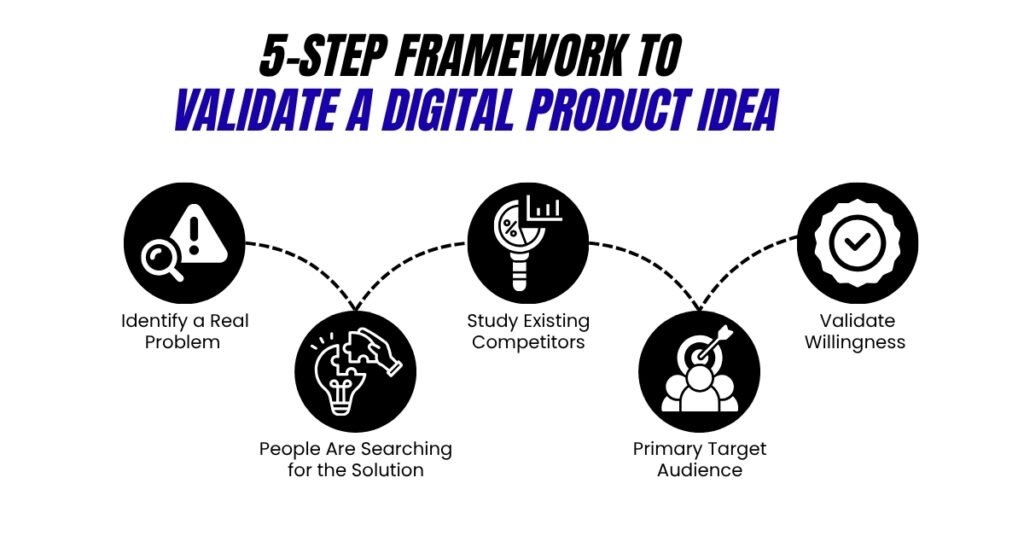
A successful digital product usually starts with research, not creation. Many creators waste time building products before checking whether people truly need them. This framework helps you validate a digital product idea step by step before investing weeks or months into creating it.
The goal is simple. You want to find proof that:
- a real problem exists
- people actively want a solution
- there is enough market demand to support your idea
These steps are beginner-friendly, practical, and easy to apply even if you are starting from scratch.
Step 1 — Identify a Real Problem People Already Have
Most successful digital products solve a painful or frustrating problem. People rarely spend money on things they do not care about. But they often pay for solutions that help them save time, reduce stress, make money, learn faster, or improve their daily life.
This is why problem-focused products usually perform better than random ideas. Instead of asking, “What should I create?” ask:
“What problem are people already struggling with?”
You can find valuable problems by observing online conversations. People openly discuss frustrations, challenges, and unmet needs across many platforms.
Good places to research include:
- Reddit discussions
- YouTube comments
- Quora questions
- Facebook groups
- Product reviews on marketplaces
For example, if hundreds of people complain about staying productive while studying, that may signal demand for a study planner, focus template, or productivity guide.
The Problem Validation Test
Before moving forward with your idea, ask yourself:
- Are people actively discussing this problem?
- Do they sound frustrated or emotionally affected?
- Are they already spending money trying to solve it?
If the answer is yes to all three, the problem likely has strong validation potential.
One important pattern many creators notice is this:
The bigger the pain point, the stronger the buying intent often becomes. People are more likely to pay for solutions connected to:
- saving time
- reducing confusion
- improving income
- solving stress
- achieving a goal faster
That is why understanding customer pain points is one of the most important parts of digital product validation.
Step 2 — Check if People Are Searching for the Solution
After identifying a problem, the next step is checking whether people actively search for solutions online. Search behavior is one of the clearest signs of real interest because people usually search when they want answers, help, or products.
This step helps you understand the difference between curiosity and demand.
For example:
Someone liking a social media post may simply find it interesting.
But someone searching:
- “best budget planner template”
- “how to stay productive while studying”
- “digital planner for freelancers”
shows stronger intent and clearer demand.
Search Demand Is Digital Proof of Interest
Search demand acts like digital evidence. It shows that people are actively trying to solve a problem instead of passively consuming content.
You do not need expensive tools to start researching demand. Many free platforms already reveal what people search for daily.
Helpful tools include:
- Google autocomplete
- Google Trends
- Pinterest Trends
- AnswerThePublic
- YouTube search suggestions
These tools help you discover:
- popular questions
- growing trends
- audience language
- recurring problems
- search intent
For example, if Google keeps suggesting related searches around a topic, it usually means many users are already searching for that solution.
One useful habit is paying attention to repeated phrases. If the same problems, questions, or keywords appear across multiple platforms, there is a strong chance the demand is real.
This stage is important because market demand should guide your product idea. Instead of guessing what people may want, you use real search behavior to make smarter decisions before creating anything.
Step 3 — Study Existing Competitors Before Creating Anything
Many beginners see competition as a warning sign. They assume a niche is too crowded and immediately give up on the idea. But in most cases, competition actually proves there is market demand. If people are already buying similar products, it means the problem is important enough for customers to spend money solving it.
A niche with no competitors may sound attractive, but sometimes it simply means there is little interest in that topic. Successful creators do not avoid competition completely. Instead, they study the market carefully to understand what customers still need and what existing products fail to deliver.
Your goal is not to be different in everything. Your goal is to solve something better, simpler, faster, or more clearly.
How to Analyze Competitors Intelligently
Competitor research is not about copying another creator’s work. It is about understanding customer expectations, identifying weak areas, and finding opportunities to improve the user experience.
One of the best places to start is customer feedback. Reviews and public discussions often reveal problems that existing products still have. Many customers openly explain what they liked, what confused them, and what disappointed them.
Pay close attention to:
- repeated complaints
- missing features
- poor explanations
- outdated information
- confusing user experience
For example, if users repeatedly complain that a template is too complicated, that may reveal an opportunity to create a simpler version for beginners.
This type of niche research helps you understand:
- what customers truly value
- where competitors are weak
- how to improve product-market fit
- what your audience still needs
What Weak Competitors Usually Reveal
Many successful digital products are not completely new ideas. They are improved versions of existing solutions. Sometimes the biggest opportunity comes from solving a familiar problem in a clearer and more useful way.
Weak competitors often reveal hidden gaps in the market. Some products may look good visually but fail to explain things properly. Others may provide too much complexity for beginners or ignore customer support completely.
These weaknesses create opportunities for creators who understand their audience better. Instead of trying to reinvent everything, focus on improving clarity, simplicity, usability, or results.
Step 4 — Define Your Primary Target Audience Clearly
One of the fastest ways to weaken a digital product is trying to target everyone. Broad products often struggle because the messaging feels generic and disconnected from real customer problems.
A clearly defined target audience helps you create stronger products and better communication. When you understand exactly who the product is for, it becomes easier to solve the right problems and speak in a way that feels relevant.
For example, a productivity planner for “everyone” sounds vague. But a productivity planner designed specifically for college students or freelancers feels more focused and useful.
Why “Everyone” Is Not an Audience
Different audiences have different goals, budgets, frustrations, and skill levels. A beginner creator searching for help online thinks differently from an experienced business owner. Their expectations, language, and buying behavior are completely different.
This is why audience specificity matters so much in digital product validation. The more clearly you understand your target audience, the easier it becomes to create something they genuinely want.
Good audience research helps you understand:
- what problems people struggle with
- what outcome they want
- how they describe their frustrations
- what may convince them to pay for a solution
The 4 Questions to Understand Your Audience
Before creating your product, answer these four questions clearly.
What Do They Struggle With?
Identify the exact problem your audience wants to solve. Strong digital products usually solve specific and emotionally important problems.
What Do They Want?
Focus on the final result your audience cares about. People rarely buy products only because they look good. They buy because they want a better outcome or experience.
What Language Do They Use?
Pay attention to the words your audience naturally uses online. This improves your SEO, product messaging, and audience connection because your content matches real search behavior.
What Would Make Them Pay for a Solution?
Some problems are interesting, but not urgent enough for people to spend money solving. Understanding buying intent helps you identify ideas with stronger commercial potential.
Step 5 — Validate Willingness to Pay Before Building
Many creators stop their research after finding audience interest. But attention alone does not guarantee sales. Someone may like your content, support your idea, or leave positive comments without ever becoming a customer.
This is why validating willingness to pay is one of the most important parts of digital product validation. Real customer behavior reveals far more than opinions or social media engagement.
The Best Validation Is When Someone Pays
One of the strongest validation signals is when people are willing to spend money before the final product even exists. It shows that the problem feels valuable and important enough for customers to invest in solving it.
This step helps creators avoid a common mistake: building products people find interesting but not useful enough to purchase.
You do not need a fully finished product to test demand. Many creators validate ideas early by using simple methods such as:
- pre-orders
- waitlists
- simple landing pages
- Gumroad test listings
- audience polls with pricing
- beta versions
For example, if people willingly join a paid beta program or sign up for early access, that is usually a much stronger signal than getting hundreds of likes online.
Why Buyer Behavior Matters More Than Attention
Online attention can sometimes create false confidence. A post may receive views, shares, or comments while generating zero actual sales. This usually happens when audience curiosity is mistaken for buying intent.
Buyer behavior reveals whether people truly see value in the solution. Customers with real intent often:
- compare products
- ask pricing questions
- look for reviews
- search for solutions repeatedly
- spend money to solve the problem faster
Creators who validate willingness to pay before building usually make smarter product decisions because they rely on real customer actions instead of assumptions.
Final Thoughts: Validate First, Create Second
Creating a digital product is exciting. Turning an idea into something useful feels creative, meaningful, and full of possibility. But successful creators understand one important truth: creating without validation can lead to wasted time, energy, and frustration.
Many digital products fail not because the creator lacked talent or effort, but because the market was never properly understood. The internet is filled with products people worked hard on but nobody truly needed. That is why research should always come before creation.
Validating a digital product idea helps you make smarter decisions before investing months of work. Instead of relying on assumptions, you learn directly from real customer behavior, audience problems, market demand, and buying intent.
The creators who succeed long term usually follow a simple process:
- research first
- listen to their audience
- identify real problems
- test ideas early
- improve based on feedback
This approach reduces risk and increases the chances of building something people genuinely want.
One of the biggest mindset shifts is understanding that validation is not meant to slow you down. It is meant to protect your time and help you create with more confidence and clarity.
You do not need a perfect idea before starting. You need a clear problem, a real audience, and proof that people care enough to search, ask, or pay for a solution.
The internet does not reward the best ideas. It rewards ideas that solve real problems for real people.
Before creating your next digital product, take time to validate the idea properly. Listen carefully to your audience, study the market honestly, and focus on solving problems that already exist. That simple habit can save you months of wasted effort and help you build products with real long-term potential.
Frequently Asked Questions
How do I know if my digital product idea is worth pursuing?
A digital product idea is usually worth pursuing when people actively search for the problem, discuss it online, or already spend money on similar solutions. Strong market demand and clear customer pain points are better indicators than personal excitement alone.
What is the best way to validate a digital product idea?
The best way to validate a digital product idea is by researching audience problems, checking search demand, studying competitors, and testing whether people are willing to pay before building the final product.
Why do most digital products fail?
Most digital products fail because creators build before validating. Common mistakes include ignoring market demand, targeting the wrong audience, and creating products based on assumptions instead of real customer needs.
Does competition mean a niche is too saturated?
Not always. Competition often proves there is already demand in the market. Instead of avoiding competition completely, focus on finding gaps where you can provide a better, simpler, or more helpful solution.
Can I validate a digital product idea without spending money?
Yes. Many validation methods are free or low-cost. You can use platforms like Reddit, YouTube comments, Google Trends, Pinterest Trends, and customer reviews to understand audience problems and market demand before investing heavily in product creation.